


Monstera represents a genus of flowering plants that comprises no less than 45 species discovered until now. With its beautiful, lush foliage specific to the tropical forests of the Americas, Monstera is one of the most popular indoor-grown plants.
The word Monstera means abnormal in Latin, which probably refers to the unusual form of their leaves.
The most popular types of Monstera for those wanting to grow this plant inside are Monstera Deliciosa and Monstera Borsigiana – in fact, these plants get commonly confused with each other and many inexperienced growers will vow they are one and the same.
These plants are extremely similar looking, so it is only understandable this may happen for the untrained eye – they are also both called the Swiss Cheese Plant due to the cuttings in their leaves.
Still, if you learn to spot the differences, you’ll know whether you came home with a Monstera Borsigiana and you should continue reading this article, or switch to our Monstera Deliciosa guide.
Watch Our Latest YouTube Video ...
Monstera Borsigiana vs. Monstera Deliciosa
- The main observable difference between a Deliciosa and a Borsigiana is the leaf size. Monstera Deliciosa has big leaves that can grow up to 3 feet in length, whereas the Borsigiana’s leaves will only reach about 1.6 feet. Borsigiana plants happen to grow faster than Deliciosa but will always be smaller when they reach maturity.
- Another difference you will observe is in the way they grow. If your monstera seems to be growing a bit messy and with a nesting-type leafstalk, you most definitely have a Deliciosa. If, however, your Monstera’s leaves grow neat, with a longer stem, you got yourself a Borsigiana.
- If you want to be sure of which type of Monstera you are caring for, the best way to do so is by checking their geniculum. This is the joint that connects the stem to the leaf. If you find the geniculum is wavy, ruffly looking, then this is a Monstera Deliciosa, but if the geniculum is straight, it’s surely a Borsigiana.
Now that we made things clear and you are sure a Monstera Borsigiana resides in your home, it’s time to learn how to care for it.
About Monstera Borsigiana
- Monstera Borsigiana originates in South Mexico’s lush tropical forests but can be found throughout all of South America.
- Because it comes from the jungle, this plant thrives when placed in a moist, humid environment.
- Propagating your Borsigiana plant can be easily done using stem cuttings.
- This plant does not react well to overwatering, so keep your Borsigiana in well-draining soil.
- The Swiss Cheese plant needs partial sunlight to develop its fenestrated foliage.
- Borsigiana plants can grow very quickly and will start to become quite disobedient, especially after their third year.
- To prevent it from becoming overwhelming, you need to start pruning it and propagating new baby plants.
- You can prune your Borsigiana plant any time of the year, even during the winter season.
- Because it grows quite fast, your Swiss Cheese Plant will need to be repotted every two years.
- This plant likes to climb on trees, so make sure you provide her with something to climb on, such as a small ladder, bamboo stick, or moss-covered rod.
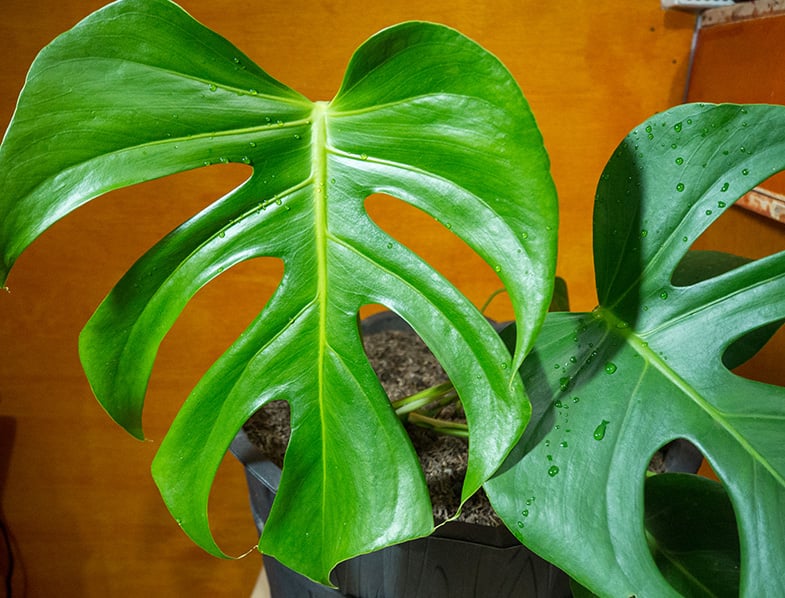
Monstera Borsigiana Features: An Overview
- One of the main features of Monstera Borsigiana is its fenestrated foliage.
- Monstera Borsigiana is an evergreen vine, meaning it retains its green leaves for more than one season.
- Its beautiful foliage can easily burn if the plant gets too much sunlight, so look out for that sign.
- Borsigiana has a straight stem from top to bottom, compared to a Monstera Deliciosa whose stem has a ruffled portion where it meets the leaf.
- In their natural habitat, Monstera Borsigiana plants develop flowers every year. However, in a potted environment that rarely happens.
- The flower of Borsigiana is of a whiteish colour and has a stem in the middle. When the fruit matures, it eventually falls off.
- Although beautiful, Monstera Borsigiana can be toxic in its natural environment.
- Potted Borsigiana plants are less toxic, but you should still keep your dog, cat, bunny, or any other animal from chewing on its leaves.
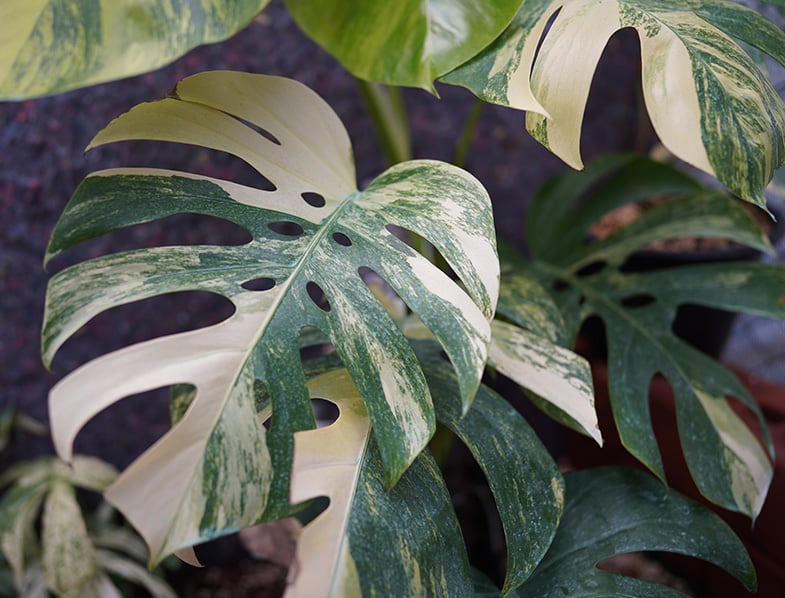
- It also has a variegated version, with beautiful green and white foliage, but it will be pretty hard to find one in common plant shops.
Growing Monstera Borsigiana
If you ever visit the forests of Panama or South Mexico, you will most definitely find lots of Monstera Borsigiana plants growing in the shade, climbing up on tall jungle trees. This means Monsteras generally love the shade and do best if you keep them in a room with filtered sunlight and occasional partial shade.
To grow healthy, Monstera Borsigiana needs soil that drains well and is rich in organic matter. Consider mixing your potting soil with pumice or perlite, to aerate it and maintain moisture.
To mimic Monstera’s natural habitat, provide your plant with a rod to cling on. There are moss-covered rods at most plant shops, so it should not be too difficult to find one to your liking. Simply place it in the middle of the pot, for better support. If you can’t find a moss rod, you can also use a bamboo stick.
Because they live in a tropical area, they thrive when there is a lot of moisture in the air. Aim for an environment with medium to high levels of humidity and keep your Monstera Borsigiana out of dry air.
You can invest in a humidifier, but if you don’t want to splurge, there is a cheaper way to help your plant. Make a wet pebble tray by using a shallow tray that you fill with pebbles (unexpected, I know), then place the Monstera pot on top of it. Pour some water into the tray and you have yourself a DIY humidifier. Refill, when necessary, but make sure the pot does not touch the water, to prevent overwatering.

- Decorative & Exotic Appeal - The monstera swiss cheese plant (Monstera adansonii) is admired for its fenestrated leaves and tropical vibes. A perfect addition to any collection of live indoor house plants, it thrives as a climbing or trailing vine in your home décor.
- Natural Air Purifier - This swiss cheese monstera plant live doesn’t just look beautiful—it also works as one of the air purifying indoor plants, improving air quality while brightening up spaces like bedrooms, offices, or living rooms.
- Versatile Growth Options - Display the monstera live plant in a hanging basket, let it trail down shelves, or train it up a moss pole. Its adaptability makes it a favorite among house plants indoors live and modern plants live houseplants collections.
- Easy Care for Beginners - The live monstera plant thrives in bright, indirect light with regular watering. Known as a low maintenance indoor plant, it’s ideal for plant lovers looking for fast growth and reliable results.
- Collector’s Favorite - Shipped in a sturdy 6″ Grower’s Pot, the monstera plant live is a must-have for enthusiasts of real indoor plants and tropical house plants live. Its unique holey leaves add character to any greenery display.
- Decorative Climbing Plant - The monstera swiss cheese plant (Monstera adansonii) is loved for its perforated leaves and vining growth habit. This swiss cheese plant live instantly brings a bold, tropical vibe to your décor and is a favorite among collectors of house plants indoors live.
- Air-Purifying Benefits - More than just décor, the swiss cheese plant helps clean the air naturally. These air purifying indoor plants are ideal for bedrooms or living areas and are also popular as real indoor plants for healthier homes.
- Versatile Décor - Display your monstera plant live in a hanging basket or let it climb a moss pole for a bold statement. This monstera adansonii live plant thrives in bright, indirect light and adapts beautifully as indoor house plants live in any style of décor.
- Great for Plant Enthusiasts - Fast-growing and rewarding, this live monstera plant flourishes with simple care. Loved by beginners and collectors alike, it’s one of the most satisfying live house plants indoors and an excellent choice for anyone wanting low light houseplants.
- Stylish and Unique - With hole-patterned leaves, this swiss cheese monstera plant live adds modern, tropical style to your home. Perfect as live indoor house plants or potted plants live, it’s both decorative and easy to care for, making it a statement piece in any room.

- Monstera Deliciosa in a 6" Nursery Pot: Introduce the exotic charm of our Monstera Deliciosa to your indoor space, flourishing in a practical 6" nursery pot. Also known as the Swiss Cheese Plant, this delightful houseplant with its iconic split leaves brings a touch of tropical elegance and air-purifying benefits to your home or office.
- Effortless Indoor Greenery Care: Embrace simplicity with our Monstera Deliciosa. Ideal for both plant enthusiasts and beginners, this adaptable and low-maintenance plant requires minimal attention, thriving in bright, indirect light conditions while maintaining enduring beauty in your indoor environment.
- Natural Air Purification with Swiss Cheese Plant: Elevate your indoor air quality with the Swiss Cheese Plant. Recognized for its unique leaf pattern, this plant not only enhances visual appeal but also acts as a natural air purifier, contributing to a healthier and fresher living space.
- Robust Swiss Cheese Plant Ideal for Larger Spaces: The 6" nursery pot makes our Monstera Deliciosa an excellent choice for larger areas. Display this exotic and resilient houseplant in spacious rooms, on desks, or in corners to bring a tropical touch to your living space.
- Quality Guarantee: Rest assured with our Monstera Deliciosa, backed by our health guarantee. Meticulously nurtured and shipped, this plant promises not just beauty but vitality, ensuring a thriving addition to your indoor plant collection.

Last update on 2025-11-29 / Affiliate links / Images from Amazon Product Advertising API
Watering Monstera Borsigiana
Some say overwatering your plants is a sign of empathy – you do it out of too much care. It happens to the best of us, but this is where the perlite we discussed above can help. Because Monstera Borsigiana is susceptible to root rot, you need to make sure you do not overwater it.
Your Borsigiana will enjoy moderate watering, meaning you leave the top 3 inches of the soil to dry before you water it again. One way to prevent excess water from causing rot is to water your Monstera until the water comes out of the pot’s drainage holes.
Let the plant sit for about 5 minutes, then remove the pot tray and pour out any excess water that drained. Then, you leave it be until you test the soil, and the top three inches are completely dry. Now you can water it again.
If you manage to find the ideal watering schedule, Monstera Borsigiana can be very easy to care for, so you can enjoy its company for years. If you are uncertain about its watering habits, keep in mind that underwatering is a much smaller problem than overwatering, so when in doubt, wait another day to wet your Monstera.

Propagating Monstera Borsigiana
You can easily propagate your Monstera Borsigiana by using stem cuts. We will try to explain the process as detailed as we can:
- Use a sterilized knife to cut a stem from your plant.
- Make sure the cut is made just below a node. The perfect cutting needs to have at least two leaves and one node.
- Put some water in a jar and place the fresh cutting in it. It should be enough water so that the stem stays underneath it, while the leaves are kept above.
- You will start noticing that the cutting starts developing roots in a few days.
- Let the roots grow for another few days, then you are ready to pot your new baby Borsigiana.
The bonus part of the propagation process is that Monstera cuttings look amazing when waiting in their water jars to develop roots, so they are a pretty addition to any room. You will soon be wanting baby Monsteras all over your house!
Make sure you keep the baby plants in medium to bright indirect sunlight, to help stimulate their growth. Choose to water them during the morning, when the sunlight is less strong, and water can be absorbed without evaporating too fast. You can build pebble humidifiers for baby Borsigiana plants as well, to simulate a tropical environment.

In Conclusion
Monstera Borsigiana may seem like an intimidating plant, as it can grow quite big, but it is a very friendly house plant, and quite easy to care for as well. If it has enough air humidity, is kept in a partially shaded room, and you make sure not to overwater it, your Monstera Borsigiana will live a long and healthy life.
What may initially drive you to a Borsigiana is its lush foliage, but you will also appreciate how easy it is to keep happy. And, when it has everything it needs, your plant will grow quite fast – a very rewarding experience for any grower!
Monstera Borsigiana FAQS
What is the difference between Borsigiana and Monstera?
“Borsigiana” is actually a type or variety of the Monstera genus. The primary difference between Monstera Deliciosa and Monstera Borsigiana lies in their leaf size, growth patterns, and certain physical features. For instance, Borsigiana’s leaves are smaller, and the geniculum (the joint that connects the stem to the leaf) is straight, unlike in Deliciosa where it’s wavy.
Why is Monstera Borsigiana so expensive?
The cost of Monstera Borsigiana, especially its variegated version, can be high due to several factors. The variegated type is quite rare and in high demand, making it more expensive. Furthermore, proper care, propagation, and maintenance of these plants can be labor-intensive, adding to their cost. The aesthetic appeal and popularity of Monsteras also drive up their price.
Is Monstera Borsigiana the same as Deliciosa?
No, Monstera Borsigiana and Monstera Deliciosa are not the same. While they belong to the same genus and are often confused due to their similar appearance, they have distinct differences in leaf size, growth patterns, and some physical features.
Is Monstera Borsigiana rare?
Monstera Borsigiana itself is not considered very rare, but its variegated version is less commonly found and is sought after, making it relatively rare and often more expensive than the regular Borsigiana or even some other Monstera types.
